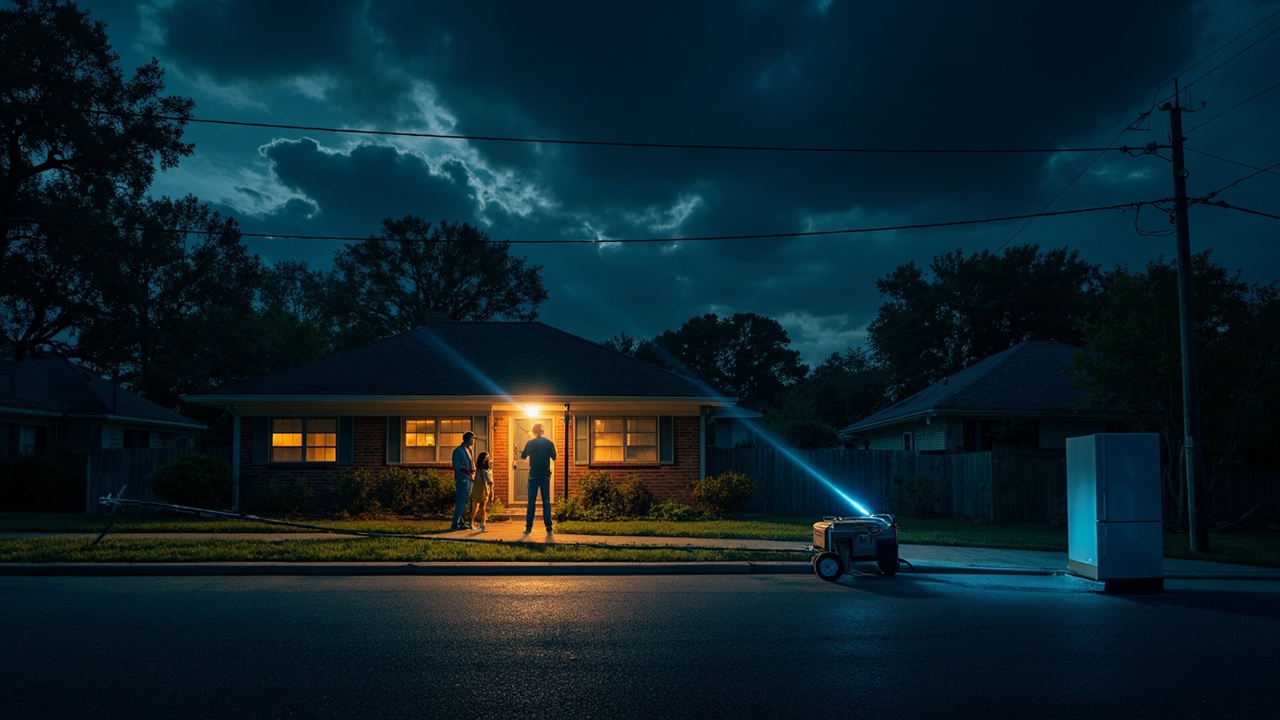
TL;DR: In Texas, report a power outage to the utility that owns the poles and wires — not the company that bills you — then keep fridge doors shut and run generators outdoors only.
Power Out in Texas? Who to Call First Makes All the Difference
When lights go out in Texas, most households contact the wrong business first. The name on the electricity bill in retail-choice areas usually sells energy and handles billing, while a different company maintains poles, wires, transformers and meters and dispatches repair crews, according to HowTexas. Municipal utilities and electric cooperatives can handle both functions for their own customers.
That distinction matters during storm season. The Atlantic hurricane season remained active through November 30, 2026, according to The Day Company, so households were urged to save the correct outage number in a phone and on paper before the next storm. On Oct. 1, 2026, AEP Texas said crews were prepared to respond to outages that could result from heavy rain and severe weather forecast across its service territory beginning Thursday and continuing into the weekend.
Treat Electrical Danger as an Emergency
When to call 911
Call 911 for fire, electric shock, a life-threatening medical event, or an immediate public safety threat, according to HowTexas. Never touch a fallen line, a damaged pole, or an object touching electrical equipment, and keep children and pets away.
Do not drive or walk through standing water when a power line may be in or near the water. If electrical equipment is wet, sparking, smoking, or producing a burning odor, do not approach the panel or meter to investigate.
Distance rules vary by utility guidance cited in the sources. In CenterPoint Energy territory, the utility instructs people to stay at least 35 feet from a downed line and call 713-207-2222, according to HowTexas. AEP Texas reminds customers to always assume downed lines are energized and dangerous, never touch a downed line or anything in contact with it including trees, fences or standing water, stay at least 10 feet away, and keep children and pets indoors immediately after the storm, according to AEP Texas. The Day Company also advises readers to assume every downed line is live, stay at least 35 feet away, keep kids and pets back, and call the utility or 911.
Who Fixes What in the Texas Market
Call the company responsible for the problem
Several electricity organizations may appear on a Texas bill or news report, but they do not perform the same work, according to HowTexas. The correct contact depends on whether the problem involves the local delivery system, the customer account, the building, or the wider grid.
For a neighborhood outage, damaged pole, transformer problem, or fallen line, contact the transmission and distribution utility, municipal utility, or electric cooperative, because the local utility owns or operates delivery equipment and dispatches crews. For a billing question, rate plan, payment arrangement, or account disconnection, contact the retail electric provider or municipal billing office. For a grid-wide alert or conservation request, ERCOT information channels apply where applicable, but ERCOT manages the bulk grid for most of Texas and does not repair a residential service line. If only one room, circuit, apartment, or building is affected, contact the property manager, landlord, or licensed electrician, because the fault may be on customer-owned or building-owned equipment.
The Day Company describes the same split in plain terms: the electric company named on the bill sells power, sets the price and sends the bill, while the utility owns the poles, wires and meter and fixes outages and downed lines.
Find the Right Utility for Your Address
Do not guess from ads or ZIP codes
Do not select an outage company from the electricity brand on an advertisement or from the name of a retail plan, according to HowTexas. A retail provider may sell plans across several delivery territories.
Check the latest electric bill and look for “delivery company,” “TDU,” “TDSP,” “electric utility,” or an outage and emergency contact. Use the service address rather than city limits, county boundaries, or ZIP codes, because utility boundaries do not always match and parts of the same city or ZIP code may be served by different utilities. Keep account identifiers available, because an outage system may request the service address, account telephone number, meter number, house number, or Electric Service Identifier, commonly called an ESI ID.
When the bill is unavailable, use the Public Utility Commission of Texas locator. The PUCT Storm Resources area directs users to utility outage maps and contact information, according to HowTexas. A utility map should be treated as an address-verification aid, not proof that every property inside a city uses the same company, a point especially relevant in metropolitan edges, annexed areas, unincorporated communities, and places where municipal, cooperative, and investor-owned systems meet.
Texas Outage Numbers by Utility
Save these contacts before the next storm
The table below covers major delivery utilities in retail-choice areas plus large city systems. It does not represent every municipal utility or cooperative operating outside the competitive retail market.
Oncor Electric Delivery serves more than 400 communities across parts of North, Central, East, and West Texas, including much of the Dallas–Fort Worth area, though territory is not defined by Metroplex or city boundaries alone, according to HowTexas. Report outages at 888-313-4747. Customers enrolled in MyOncor Alerts may text OUT to 66267. Tools include the Oncor Storm Center and online outage reporting.
CenterPoint Energy covers Greater Houston and surrounding portions of the Upper Gulf Coast and maintains electric delivery infrastructure in its certificated territory, according to HowTexas. Report outages at 713-207-2222 or through the Action Center online report form. Tools include the CenterPoint Outage Tracker and Power Alert Service. The Day Company also lists 800-332-7143 for the Houston area.
AEP Texas serves separate service areas across South Texas and West Texas, including parts of the Coastal Bend, Rio Grande Valley, and inland western regions, according to HowTexas. Report outages at 866-223-8508 or through the AEP Texas online reporting system. Tools include the AEP Texas Outage Map and outage-status search. Customers can sign up for free mobile outage alerts at aeptexas.com/alerts, according to AEP Texas.
Texas-New Mexico Power serves disconnected territories in North-Central Texas, the Gulf Coast, and West Texas, according to HowTexas. Report outages at 888-866-7456, selecting option 1 for an outage or estimate and option 2 for an equipment hazard. Tools include the TNMP Power Outage Map and online report button. The Day Company notes that TNMP asks customers to report on its map before calling.
CPS Energy in San Antonio can be reached at (210) 353-4357, and Austin Energy in Austin can be reached at 512-322-9100, according to The Day Company. Austin Energy also accepts outage reports by text with OUT to 287846. The Day Company describes Corpus Christi, the Valley, Laredo, Abilene, and San Angelo as part of the AEP Texas pattern, and parts of the Gulf Coast, North Texas and West Texas as part of the TNMP pattern.
What to Do in the First 10 Minutes
Check, report, unplug, keep doors shut
The Day Company recommends five steps in order: check whether only the home is dark by looking at the breaker box and neighbors’ lights, because a tripped breaker may be the cause; check the utility outage map, then report if the outage is not shown; unplug electronics; keep the fridge and freezer shut; and stay away from downed lines.
Unplugging appliances and electronics helps avoid damage from power surges when power returns, according to Ready.gov guidance summarized by The Day Company. A separate preparedness summary from Power Outage Preparedness: Before, During and After gives the same advice for sensitive electronics and recommends leaving one light switched on to know when power returns.
Report the outage to the utility and check its outage map instead of calling repeatedly, according to Power Outage Preparedness: Before, During and After. For AEP Texas customers, safety hazards, downed lines or tree hazards can be reported at aeptexas.com/outages or by calling 866-223-8508, according to AEP Texas.
How Long Food Stays Safe Without Power
The 4-hour, 48-hour and 40-degree rules
A closed refrigerator keeps food cold for about 4 hours. A full, closed freezer holds its temperature for about 48 hours, according to Ready.gov information summarized by The Day Company and How to Use a Generator When the Power Goes Out. A half-full freezer warms faster than a full one. Power Outage Preparedness: Before, During and After adds that a half-full freezer holds for about 24 hours.
Every opening lets cold air escape, so plan meals to open doors as little as possible. Keep a thermometer in the fridge and freezer to know the real temperature.
The rule to remember is to throw out food that has been at 40°F or warmer for 2 hours or more, according to The Day Company. How to Use a Generator When the Power Goes Out states the same threshold: use a thermometer and throw food out if the temperature is 40°F or higher. Power Outage Preparedness: Before, During and After adds that frozen food that still has ice crystals or is at 40 degrees F or below can be refrozen, and food should never be tasted to decide safety.
Generators, Carbon Monoxide and Storm Readiness
Outdoors only and at least 20 feet away
Generators go at least 20 feet from windows, doors, and attached garages, and carbon monoxide can kill in minutes without a detectable smell, according to The Day Company. How to Run a Generator Safely states that the U.S. Consumer Product Safety Commission says never to use a portable generator inside a home, garage, basement, crawlspace, shed, or other enclosed area, even with doors or windows open, and to operate it outdoors only at least 20 feet from homes and buildings with exhaust directed away from windows, doors, and vents.
Other operating guidance includes keeping the generator dry, connecting appliances with heavy-duty extension cords, letting the generator cool before refueling because fuel spilled on hot engine parts can ignite, and installing carbon monoxide detectors, according to How to Use a Generator When the Power Goes Out. Households should never heat a home with a gas stove or oven because of carbon monoxide, fire, burn, and appliance-damage risk.
Preparation before storm season includes flashlights with extra batteries rather than candles, water and nonperishable food for several days, a cooler and ice packs for medicine that must stay cold, batteries or backup power for medical devices, a thermometer for fridge and freezer, carbon monoxide detectors with battery backup, a charged power bank, a full gas tank, and the utility outage number written down, according to The Day Company. AEP Texas said on Oct. 1, 2026 that its crews and business partner crews were on standby, vegetation management and tree-trimming crews had been activated, storm assessment teams were on alert, trucks were stocked with supplies and fuel, and administrative staff were coordinating with local emergency management officials.
Recent Texas history shows why long outages must be part of planning. Winter Storm Uri in February 2021 led to loss of power for more than 4.5 million Texas homes, according to the University of Texas at Austin Energy Institute as cited by VirtuGrid, while a University of Houston survey found 69% of Texans lost electricity for an average of 42 hours. On May 16, 2024, a Houston derecho left 922,000 CenterPoint outages that fell to nearly 15,000 in the following week, and on July 8, 2024, Hurricane Beryl left 2.26 million CenterPoint customers without power, according to VirtuGrid.