TL;DR: Your household can be safer today by knowing local risks, writing a family emergency plan, building a go-bag and supply kit, and joining community preparedness efforts.
Why home is the starting point
National Preparedness Month helps remind Americans how important it is to prepare for disasters, and the theme highlighted by FEMA is Preparedness Starts at Home, focused on simple ways you can begin preparing today, according to Preparedness Starts at Home: Four Steps You Can Take Today | FEMA.gov.
That FEMA blog post outlines four key actions for any household in the United States: know your risk, make a family emergency plan, build an emergency supply kit, and get involved in your community by taking action to prepare for emergencies.
The message is intentionally scaled to household action. No matter what part of the U.S. you live in, there are disaster risks, and learning what they are where you live helps you learn how to stay safe. Knowing what to do before an emergency strikes can reduce stress and save both time and money. Having enough food, water and medicine can help you stay safe and comfortable until help arrives. And because emergencies can happen fast and responders are not always nearby, basic community skills can matter in the first minutes.
For households focused on self-reliance, the value is practical: alerts on your phone, a written plan on the refrigerator, a packed bag by the door, and training that lets you help neighbors. For more information on how you can begin preparing today, FEMA points households to Ready.gov, which hosts plan forms, checklists, and local-risk explainers.
Step 1: Know your risk where you live
Check local sources and set alerts
The first FEMA-recommended action is to identify the hazards most relevant to your address. Check your state and local emergency management websites for tips on how to prepare. Those offices publish hazard profiles, evacuation information, shelter locations, and notification systems for counties and cities.
Another way to learn about local risk is through the FEMA app. According to the FEMA blog post, the app lets you set up alerts specific to your area and learn more about the disasters common in those areas. You can also sign up for other types of emergencies and alerts that will help you stay informed.
The broader campaign behind this advice is National Preparedness Month, observed each September and established by FEMA in 2004 to encourage Americans to prepare for emergencies and disasters, as described in the 2025 National Preparedness Month Toolkit. That toolkit urges households to share only information from official government agencies such as FEMA, the National Weather Service, state emergency management offices and local authorities, and trusted organizations such as the American Red Cross.
In practice, that means two household tasks this week: look up your county emergency management page and confirm how warnings reach you, then enable location-based alerts in the FEMA app. The National Preparedness Month | Ready.gov page similarly encourages households to explore various disasters and emergencies on Ready.gov to figure out what you need to do to stay safe.
Step 2: Make a family emergency plan
Write down who does what and where to meet
A written household plan removes guesswork when phones fail, roads close, or family members are in different places. You can begin by creating a free Family Emergency Plan quickly and easily with a fillable form referenced by FEMA.
FEMA advises households to keep several factors in mind when developing that plan: different ages of members within the household, ways to assist others, locations frequented, dietary needs, and medical needs including prescriptions and equipment.
Those five factors force useful conversations. Ages matter because children, teens, older adults and caregivers have different mobility, communication and supervision needs. Assisting others covers neighbors, relatives or visitors who may need transportation or check-ins. Frequently visited locations matter because school, work, worship, daycare and shopping areas may face different orders. Food needs and medical needs, including prescriptions and equipment, determine what must travel with you if you leave quickly.
The Ready campaign echoes that planning now pays later. Making a plan early helps reduce stress and save time and money, according to National Preparedness Month | Ready.gov. The same page notes that taking time to prepare now can help save thousands of dollars and give peace of mind when the next disaster or emergency occurs, and points households to a low- and no-cost tips page for affordable steps.
A workable one-page plan names out-of-area contacts, meeting spots inside and outside the neighborhood, school pickup rules, pet responsibility, and where the go-bag and documents are stored. Practice the route out of the home and the drive out of the neighborhood before you need it.
Step 3: Build an emergency supply kit and go-bag
Stock food, water, medicine and comfort
FEMA frames a kit as a bridge until help arrives. Having enough food, water and medicine can help you stay safe and comfortable until help arrives, and having what you need can prevent injury, help you stay safe and comfortable and prevent damage to your home.
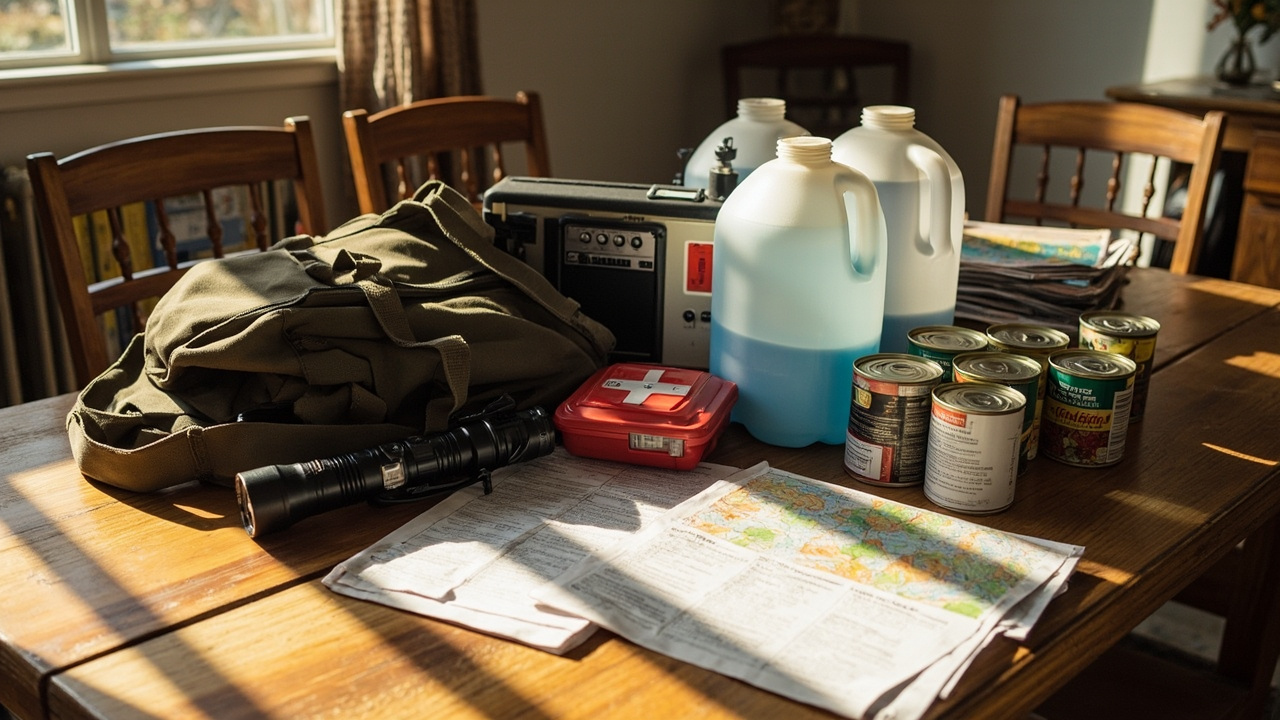
Build a go-bag with essentials you might need so you do not need to scramble in an evacuation situation. In addition to food and water, the FEMA blog post suggests considering items for communication, light, first aid, signaling, air protection, sheltering in place, sanitation, utilities, food access and navigation.
That covers a battery-powered or hand-crank radio and a NOAA Weather Radio with tone alert, a flashlight, a first aid kit, extra batteries, a whistle to signal for help, a dust mask to help filter contaminated air, plastic sheeting with scissors and duct tape to shelter in place, moist towelettes with garbage bags and plastic ties for personal sanitation, a wrench or pliers to turn off utilities, a manual can opener for food, and local maps. A fuller list of supplies is available at Build A Kit on FEMA.gov.
More detail appears on Build A Kit | Ready.gov, which explains that after an emergency you may need to survive on your own for several days and that a disaster supplies kit is a collection of basic items your household may need. That page advises storing items in airtight plastic bags and placing the kit in one or two easy-to-carry containers such as plastic bins or a duffel bag.
For drinking and sanitation, that Ready.gov kit page lists water at one gallon per person per day for several days, plus at least a several-day supply of non-perishable food. It repeats the radio, flashlight, first aid kit, batteries, whistle, dust mask, sheeting and tape, sanitation supplies, wrench or pliers, can opener and maps, and adds a cell phone with chargers and a backup battery.
Add personal, medical and document needs
Basic gear is only the start. Households should layer in needs tied to health, age, pets and paperwork.
Build A Kit | Ready.gov suggests considering soap, hand sanitizer and disinfecting wipes for surfaces; prescription medications, with attention to organizing and protecting prescriptions, over-the-counter drugs and vitamins because an emergency can make refills or an open pharmacy hard to find; non-prescription medications such as pain relievers, anti-diarrhea medication, antacids or laxatives; prescription eyeglasses and contact lens solution; infant formula, bottles, diapers, wipes and diaper rash cream; pet food and extra water; cash or traveler's checks; important family documents such as copies of insurance policies, identification and bank account records saved electronically or in a waterproof portable container; a sleeping bag or warm blanket for each person; a complete change of clothing appropriate for climate plus sturdy shoes; a fire extinguisher; matches in a waterproof container; feminine supplies and personal hygiene items; mess kits, paper cups, plates, paper towels and plastic utensils; paper and pencil; and books, games, puzzles or other activities for children.
Maintenance matters as much as purchase. That Ready.gov page advises keeping canned food in a cool, dry place, storing boxed food in tightly closed plastic or metal containers, replacing expired items as needed, and rethinking needs every year to update the kit as family needs change.
Storage location matters too. Since you do not know where you will be when an emergency occurs, the page recommends preparing supplies for home, work and cars. At home, keep the kit in a designated place ready to leave quickly and make sure all family members know where it is kept. At work, be prepared to shelter at least 24 hours with food, water, necessities like medicines and comfortable walking shoes in a grab-and-go case. In the car, keep emergency supplies in case you are stranded.
Step 4: Get involved and learn to help
Take a class and join local response groups
FEMA's fourth action moves beyond the front door. Emergencies can happen fast and emergency responders are not always nearby. Learning ways to quickly help in these situations may let you save a life, and one path is taking a first aid class through non-profit organizations or local government groups.
Another path is joining a Community Emergency Response Team, known as CERT, and getting trained on basic disaster response skills such as fire safety, light search and rescue, team organization and disaster medical operations.
The National Preparedness Month | Ready.gov page adds related options: taking a first aid class through many organizations in the community, joining a Community Emergency Response Team program for the same core skills, and taking a free online independent study course through FEMA's Emergency Management Institute or a CPR course through the American Red Cross to help the community become more prepared. The FEMA blog post also references the free online independent study course through the Emergency Management Institute and a CPR course through the American Red Cross.
For self-reliant households, the sequencing is straightforward. First aid and CPR cover breathing, bleeding and cardiac events before professionals arrive. CERT adds team organization, light search discipline, utility awareness and disaster medical triage at the neighborhood level. Independent-study courses add incident vocabulary so volunteers can follow official instructions without adding confusion.
What to do today
Start with four household moves drawn directly from the federal guidance above: enable local alerts and review county emergency pages, complete the fillable family plan with ages, assistance roles, frequent locations, food needs and medical needs including prescriptions and equipment, pack or refresh a go-bag and home kit using the Build A Kit checklist, and enroll in first aid, CPR, CERT or an Emergency Management Institute course.
Preparedness Starts at Home works because it treats readiness as routine maintenance, not a one-time purchase. Small, verifiable steps — alerts set, plan printed, kit packed, class scheduled — leave a household calmer, more mobile and better able to help neighbors when minutes matter.