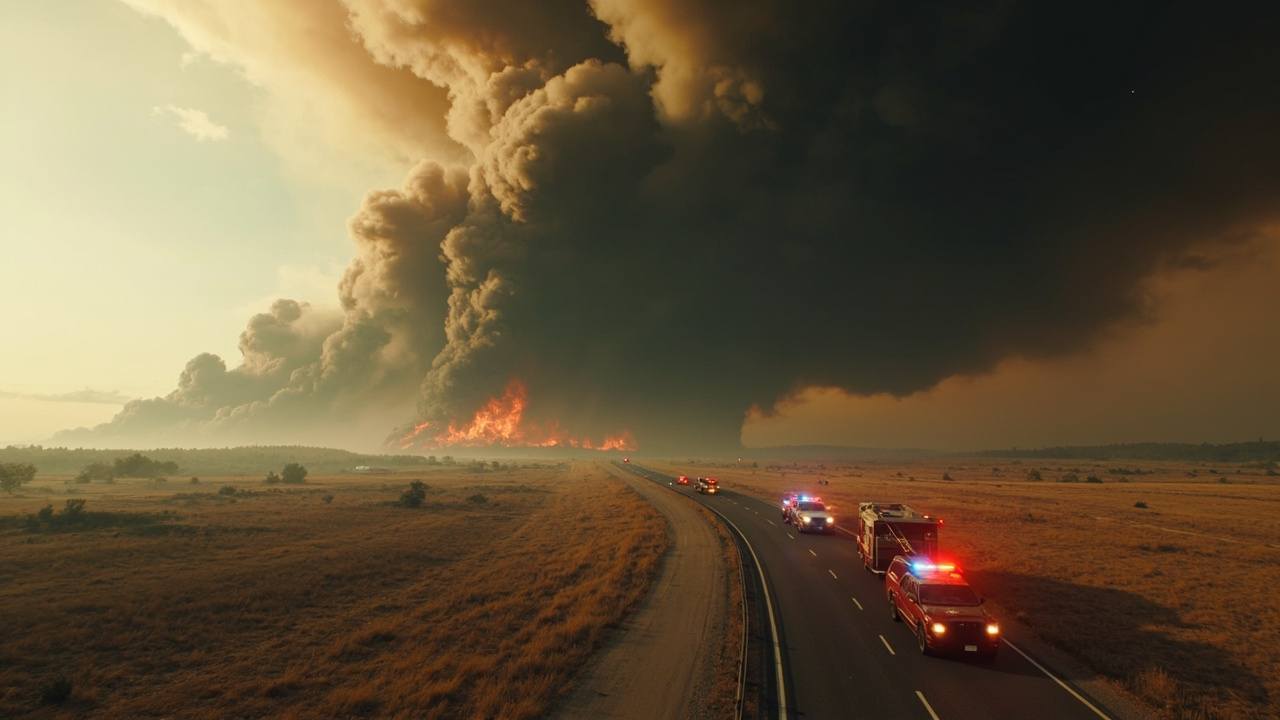
TL;DR: Oklahoma Emergency Management issued an Evacuation Immediate for Scott and the Caddo-Canadian county line on September 15, 2026, telling residents in a mapped rural box to leave at once toward State Highway 37, and that order was later lifted Tuesday evening as crews and aircraft kept fighting the Gracemont Fire.
What the Sept. 15 evacuation order required
The alert was an Evacuation Immediate with Immediate urgency, according to GovOneStop's posting titled "Oklahoma Extreme Evacuation Immediate | Effective 09/15/2026 11:11."
The headline identified a wildfire with immediate evacuation for Scott and along the Caddo-Canadian County Line. The event type was listed as Evacuation Immediate.
The effective time was September 15, 2026 at 11:11 a.m., with expiration listed as September 15, 2026 at 1:11 p.m., according to GovOneStop. A separate local alert listing described issuance at 1:11 p.m. CDT with expiration at 3:11 p.m. CDT, reflecting the same Tuesday afternoon warning in local time.
The description said that at 1303 a large and destructive wildfire was burning out of control in northern Caddo County near Scott and spreading east-northeast rapidly. It warned that wildfires can damage or destroy structures and can harm or kill people and animals.
For safety, residents were told to evacuate immediately toward State Highway 37 to the north. The instruction named the evacuation box as those between CR 2670 and CR 2690/S Mayberry Road and SW 74th and CR 1130, and told them to leave the area now to avoid injury or death.
The instruction said do not delay to pack belongings. It said roads in the area may be impacted by fire and smoke, never drive into heavy smoke, and slow down and move over for emergency vehicles.
The area description listed Caddo and Canadian counties. The forecast office was listed as Oklahoma Emergency Management, and the sender was listed as [email protected], according to GovOneStop.
Where Scott sits and who was told to leave
Scott is an unincorporated town along the Caddo and Canadian county line, according to KOCO's report titled "Evacuation orders lifted for Scott, Oklahoma due to wildfire."
KOCO reported that the evacuation alert said a large and destructive wildfire was spotted burning shortly after 1 p.m. Tuesday. The flames were out of control in northern Caddo County near Scott.
The fire was spreading east-northeast rapidly, according to the evacuation order as summarized by KOCO. People were told to evacuate toward State Highway 37 to the north.
The named roads were County Road 2670 and County Road 2690/South Mayberry Road and Southwest 74th Street and County Road 1130, according to KOCO. Residents between those roads were told to leave immediately.
The Oklahoman, in its report titled "Evacuations ordered near Scott, Oklahoma, as Caddo County wildfire spreads," said residents of some parts of Caddo and Canadian counties were ordered to evacuate as the large, destructive wildfire continued to rage.
The Oklahoman reported that the Oklahoma Department of Emergency Management announced at 1:03 p.m. on Tuesday, Sept. 15, that the ongoing wildfire was rapidly spreading in northern Caddo County near Scott, Oklahoma. That report identified the blaze as the Gracemont Fire.
Order lifted Tuesday evening
The evacuation order has since been lifted, according to KOCO. That update was published at 6:14 p.m. CDT on Sept. 15, 2026.
KOCO reported that the Oklahoma Department of Emergency Management lifted the evacuation order for the town of Scott as crews and several aircraft worked to put out a large fire burning for days in Caddo County.
News9, in its report titled "Firefighters continue to battle Caddo Co. wildfire that sparked Sunday," also reported that evacuation orders were lifted Tuesday evening as aircraft and multiple fire agencies from across the state continued work to put out the fire.
The lifting did not mean the incident was over. KOCO reported that several crews and aircraft were still working to put out the fire when the order was lifted.
The Gracemont Fire: start, spread and size
Authorities are calling this the Gracemont Fire, according to KOCO. It is one of several fires that burned across Oklahoma over the prior few days.
KOCO reported that the fire initially broke out Sunday afternoon north of Highway 152 near County Road 2670 between Binger and Cogar. The fire seemed to settle down overnight and into Monday morning, but rekindled Monday afternoon and again sent large plumes of smoke into the air.
The Oklahoman reported that the fire had been raging since Sunday, Sept. 13, according to Tuttle Emergency Management.
Oklahoma Forestry Services officials said the fire burned an estimated 3,000 acres and was 0 percent contained, according to KOCO. The Oklahoman reported that the blaze had already burned more than 3,000 acres and continued to spread northeast.
KGOU, in its report titled "Heat, drought fuel wildfires across Oklahoma as localities work on prevention," reported that crews were still fighting the Gracemont Fire east of Binger and west of Cogar. That report said the fire torched about 3,000 acres and was at 0% contained as of Monday morning, according to the Oklahoma Forestry Services.
KGOU identified it as the biggest fire in that area of Caddo County. KOCO reported that other fires burned approximately 1,250 acres during the same period.
News9 reported a lower early figure of more than 2,300 acres burned, with bulldozers used to create fire breaks and multiple planes dropping water in the region.
The exact number of homes and other structures damaged had not been confirmed in early reporting. KGOU reported that a couple of structures burned and crews were still assessing damage to get a clearer picture.
Drought, heat and burn bans raised risk
Statewide fire conditions were elevated on Sept. 15. KGOU reported that fires burned about 5,200 acres in the state and that 53 counties were under burn bans Monday afternoon.
KOCO reported that as of Tuesday, 55 counties statewide were under burn bans. A separate weather report the same day said 56 out of 77 counties were in an active burn ban, showing how rapidly county-level restrictions were changing.
Oklahoma Forestry Services officials said recent wildfires were resistant to control efforts, so people should be aware, follow burn ban restrictions and avoid activities that could spark a fire, according to KGOU.
Jacob Hickey, chief of the Cogar Volunteer Fire Department, told KGOU his crew was called out Sunday afternoon and had been working to suppress the fire since. He said the head of the fire mostly stopped progressing and crews were working to keep it from growing wider.
Hickey said heat exhaustion cases occurred but nothing that could not be treated on scene, according to KGOU. He said a few houses were still evacuated at that point, but about 80% of residents were back home.
Hickey said a lawn mower started the fire, according to KGOU. He described dry conditions by saying everything was dry, the area had not had rain in a long time, and extreme temperatures dried vegetation until it was dormant.
Violating burn bans can result in significant penalties, according to KOCO. Anthony Reed, chief agent of inspections for the Oklahoma State Fire Marshal's Office, said most violations he sees are between $500 and $1,000 and up to a year in a county jail.
Reed also said Oklahomans need to pay attention to exact language in each ban because the bans are not all the same, according to KOCO.
What households should do during an immediate evacuation
Do not wait to gather belongings when the order says leave now. GovOneStop's instruction said do not delay to pack belongings, and the emergency management message repeated that warning.
Leave toward the assigned route. In this incident, the assigned direction was north toward State Highway 37, according to GovOneStop and KOCO.
Expect roads to be affected by fire and smoke. GovOneStop warned that roads in the area may be impacted by fire and smoke.
Never drive into heavy smoke, according to GovOneStop. Turn around, wait for conditions to change, or follow directions from emergency personnel in the area rather than pushing through low visibility.
Slow down and move over for emergency vehicles, according to GovOneStop. Tuttle Emergency Management also asked drivers to yield to emergency service equipment during the Caddo County fire response, according to News9's earlier report.
Limit nonessential water use if the town asks. News9 reported that the Town of Binger asked residents to refrain from excess water usage because officials expected the fire response to continue using the town water supply.
Self-reliance lessons from a fast rural fire
Keep vehicle fuel, medications, identification, chargers, water and snacks ready enough to leave without packing. The Scott order gave no packing window and told residents to leave immediately.
Plan for livestock and pets before smoke arrives. GovOneStop warned that wildfires can harm or kill people and animals, making early animal movement especially important on rural roads.
Know county road numbers around your home. The entire Scott evacuation was defined by county roads and one highway, not street addresses.
Monitor Oklahoma Department of Emergency Management messages and local fire agencies. The Oklahoman attributed the 1:03 p.m. announcement to the state emergency management department, while early fire location and history came from Tuttle Emergency Management and local volunteer departments.
Treat lifted as still dangerous. Crews, bulldozers and aircraft continued working after the Tuesday evening lift, according to KOCO and News9, with hot spots and smoke still possible.
Sources referenced
- Oklahoma Extreme Evacuation Immediate | Effective 09/15/2026 11:11 | GovOneStop (https://govonestop.com/nws/oklahoma-extreme-evacuation-immediate-effective-09152026-1111)
- Evacuation orders lifted for Scott, Oklahoma due to wildfire - KOCO (https://www.koco.com/article/scott-oklahoma-evacuation-caddo-county-gracemont-fire/73746036)