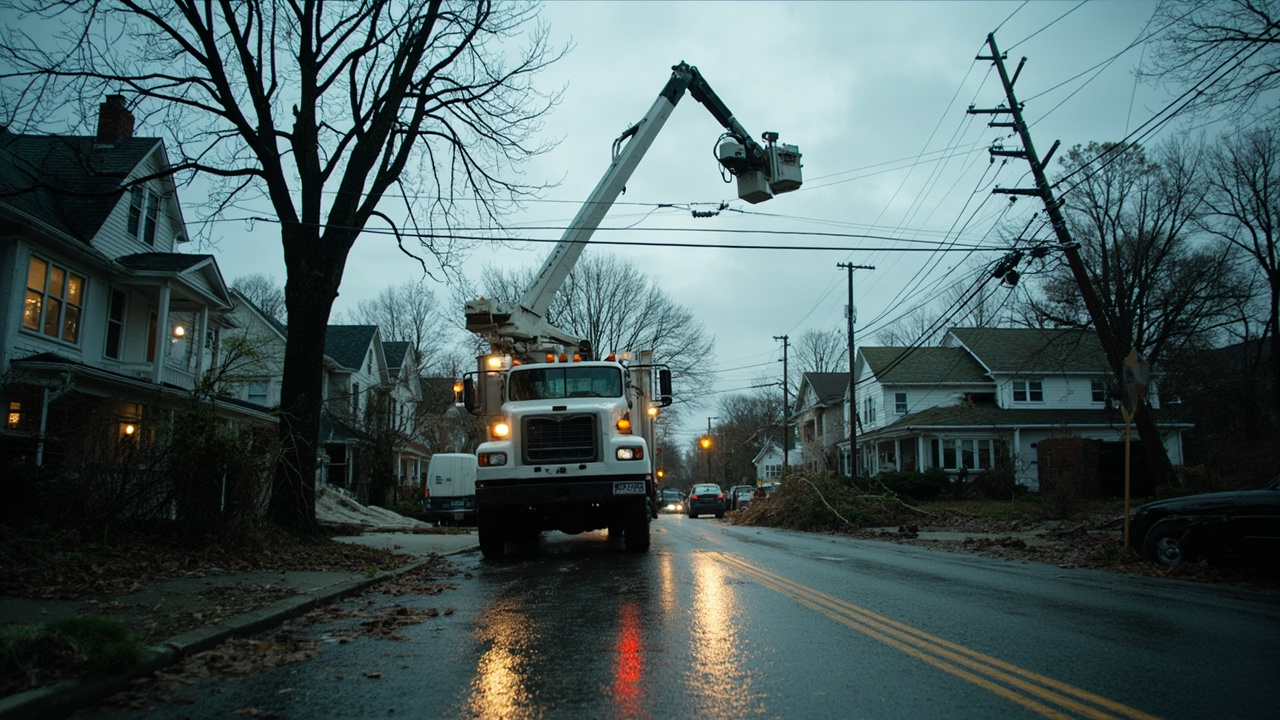
TL;DR: Orange and Rockland Utilities crews restored power to more than 32,000 customers after a weekend nor'easter that began Saturday morning, with 550 customers still awaiting restoration as crews stayed mobilized.
Weekend nor'easter drives second-day restoration push
Orange and Rockland Utilities emergency response crews remained mobilized to repair damage and restore outages from the weekend nor'easter, according to the September 27 evening release titled "Storm Update: O&R Crews Continue to Repair Damage and Restore Power Throughout the Service Territory."
That update said crews had restored power to more than 32,000 customers since the storm began Saturday morning and would continue working to restore service to the remaining 550 customers.
An earlier same-day release titled "Restoration Update: O&R Crews Continue Restoring Service Through Second Day of Stormy Weather" placed the morning progress at more than 24,000 customers restored. That morning statement was issued from Pearl River, New York, at 10:50 a.m. on September 27, 2026, and described winds and rain continuing to affect the region for a second day.
The morning update said the emergency response workforce remained mobilized and ready to restore power. It said a total of 175 mutual aid emergency response workers had been added to assist with the effort.
The combined workforce was assigned to continue restoring power to remaining or newly reported outages throughout the remainder of the weekend, the morning update said. The evening update likewise said crews remained mobilized to repair damage and restore outages from the weekend storm.
For households, the sequence shows substantial restoration during September 27 even as new outages remained possible while wind and rain continued. O&R strongly recommended in both updates that customers report new outages immediately so crews could restore service as quickly as possible.
How many customers were still without power
The number of customers without service fell sharply between the two September 27 updates.
The 10:50 a.m. update reported approximately 3,300 customers out of service at that time. The later update reported 550 customers remaining to be restored after more than 32,000 restorations since Saturday morning.
O&R serves approximately 300,000 electric customers in southeastern New York State, where its franchise name is Orange and Rockland Utilities, and in northern New Jersey, where it operates as Rockland Electric Company, according to the company description in the releases. It also provides natural gas service to approximately 140,000 customers in New York.
The company is a wholly owned subsidiary of Consolidated Edison, Inc., described in the releases as one of the nation's largest investor-owned energy companies. O&R is identified as a regulated utility.
The drop from approximately 3,300 customers out in the morning to 550 customers remaining in the later update reflects continued field work through the day. The releases did not ask customers to assume that all outages were already known to the company.
Instead, O&R said customers should not assume the utility automatically knows about an outage. Reporting remains important because crews use outage reports to locate remaining trouble and restore service as quickly as possible.
Where the remaining outages were concentrated
The evening update listed the most heavily impacted areas by county-level customer counts.
It listed Sullivan with 336 customers, Orange with 73 customers, and Rockland with 50 customers. Those three county totals accounted for 459 of the 550 customers described as remaining to be restored in that update.
The morning update provided a more localized breakdown for parts of Orange County, New York. It listed Greenville with 254 customers out, Middletown with 447 customers out, Town of Tuxedo with 233 customers out, and Wallkill with 341 customers out.
The morning update also identified Rockland, Sullivan, and Passaic as affected areas under broader headings for New York and New Jersey. It listed New York headings for Orange, Rockland, and Sullivan, and a New Jersey heading for Passaic, without providing customer numbers for every heading in the retrieved text.
Households in those named communities faced the highest likelihood of extended outage exposure during the second day of wind and rain. O&R directed customers to its Outage Map for current outage information.
The releases also referenced a brief video providing step-by-step guidance on basic operation of the Outage Map. Checking that map can help a household confirm whether its outage is recorded and follow restoration status without assuming the company already has the report.
How O&R sequences restoration work
O&R said restoration work proceeds after weather conditions allow safe damage assessment and repair.
Once weather clears enough to safely assess damage and begin electric service restoration, crews give priority to clearing downed wires blocking roads, the company said. That first priority addresses immediate access and safety hazards.
Crews also prioritize repairs to critical and emergency facilities. The examples given were police and fire stations and hospitals.
The next priority is work that restores power to the largest number of customers as quickly as possible. That approach means larger blocks of customers may be restored before smaller outages and individual customer outages.
Crews then restore smaller outages and individual customers' outages, according to the restoration description. That sequence is important for preparedness planning because isolated homes, single services, and scattered damage may wait longer even after nearby neighborhoods return.
The morning update said overhead line technicians, vegetation removal specialists, and other experts were part of the damage-assessment and restoration effort described in regional storm coverage. The O&R releases themselves emphasized that the emergency response workforce remained mobilized through the weekend.
For households still without power after the larger repairs, the practical implication is to keep outage reports active, monitor the Outage Map, and maintain backup lighting, communications, and medication plans until the individual restoration is complete.
How to report an outage
O&R said customers should report an outage rather than assume it is already known.
The company said customers can report an outage and check restoration status through its reporting channels and Outage Map. The releases state: "If you experience a power outage, don't assume that O&R automatically knows about it."
The releases strongly recommend immediate reporting of new outages. Prompt reporting helps crews identify newly damaged sections and restore service as quickly as possible.
Customers were also advised to keep O&R's toll-free number, 1-877-434-4100, near the phone for reporting outages. That number is used both for outage reports and for reporting downed wires.
The releases also cautioned that a cordless phone may not work during an outage when its base station plugs into a wall outlet. Households that rely on cordless handsets should plan for an alternative way to call the utility or emergency services during a loss of power.
Downed-wire and storm-damage safety
O&R warned the public not to touch or approach any downed wire.
The company said to assume the wire is energized and dangerous. Customers should call O&R immediately at 1-877-434-4100. Depending on the situation, customers may also consider calling local police to divert traffic from the downed wire's location until a crew arrives.
The safety guidance also said to maintain a distance of at least 50 feet from downed wires and anything they contact, including puddles of water and fences. Children should be supervised so they are not in the vicinity, and pets should be kept on a leash or otherwise secured.
If a fallen wire is draped over a car, the guidance says not to approach the car for rescue attempts. Occupants should remain at a safe distance, with efforts made to keep the vehicle occupant calm while emergency personnel handle the situation where possible.
Pole-top transformers should also be avoided when knocked to the ground. The releases describe those as small, grey-colored metal drums attached to wires at the tops of most utility poles.
Downed equipment may be hidden by storm debris or standing water. Households should avoid walking or driving through areas with fallen limbs, flooded streets, or sagging lines and should treat every downed wire as a live hazard.
Generators, emergency supplies, and EV readiness
Portable generators pose a serious hazard if used improperly, according to the O&R safety guidance. Generators should be used and installed according to manufacturer instructions.
A wrong connection could feed electricity back through power lines and endanger repair crews. The company said never to plug a generator into a wall unit, use it indoors, or set it up outdoors near open home windows or air-handling vents.
The releases advised keeping emergency equipment within reach. Listed items include a portable radio, flashlights, spare batteries, first-aid kit, cell phone, and important medications.
Households were also reminded to keep O&R's toll-free number near the phone. Having the number accessible avoids delays when a cordless phone, internet connection, or home charging setup is unavailable during an outage.
For electric-vehicle owners, the releases advised keeping the vehicle charged in anticipation of a longer-than-expected outage. The stated guidance is to keep an EV charged between 75-90% in case of emergency.
The releases note that EVs use home charging rather than gasoline service. All EVs come with a plug and adapter compatible with outlets in a garage or outside a house. Home Level 2 chargers charge at a higher rate than a regular outlet because they use 220 volts, described as the same voltage used by a clothes dryer.
Households unable to charge at home were directed to take the vehicle to a publicly accessible Level 2 or DCFC Fast Charger. Maintaining charge before storm impacts arrive reduces the risk of being unable to travel for supplies, shelter, medical needs, or evacuation if outages persist.