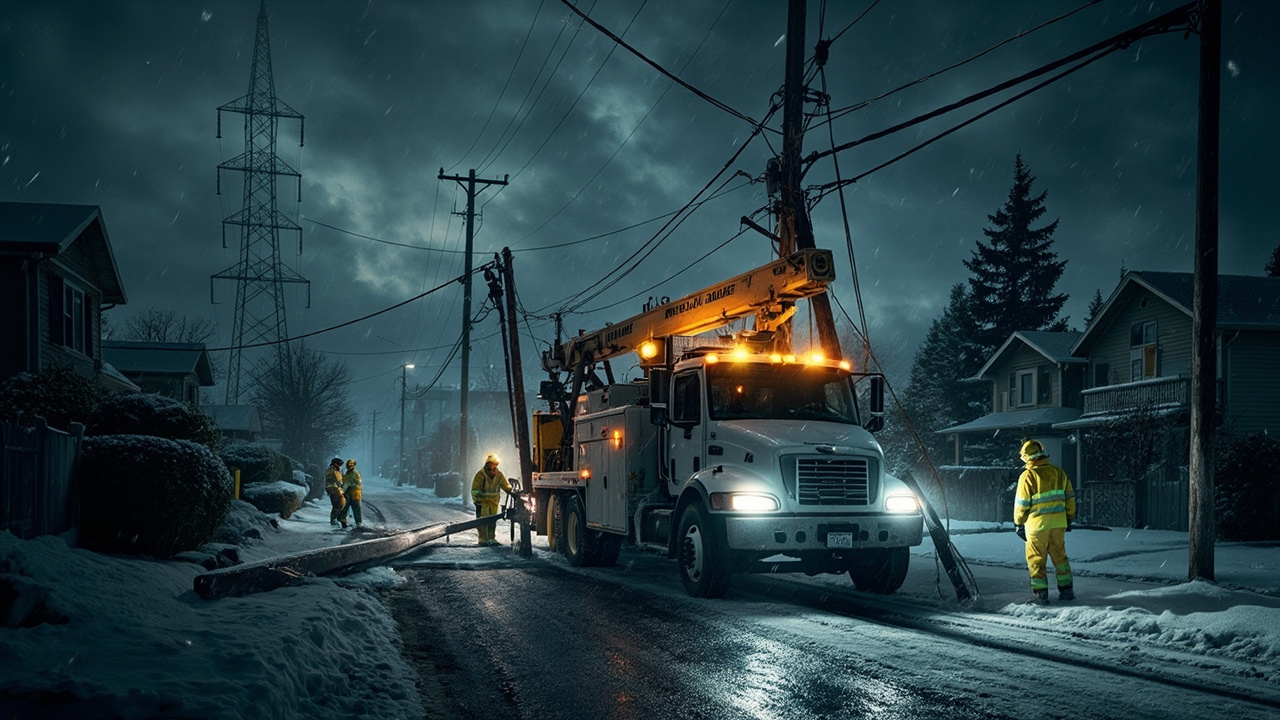
TL;DR: Puget Sound Energy restores transmission lines and essential services first, then distribution and individual service lines, with regional restoration estimates typically posted within 24–48 hours of a large event.
Puget Sound Energy describes two different restoration tracks for households, according to PSE | How Power Gets Restored. Region-wide outages affect several thousand to several hundred thousand customers and are typically caused by significant weather events. Local outages are day-to-day outages that occur outside a region-wide storm or emergency event.
In the Pacific Northwest, PSE says region-wide outage events are most commonly caused by fall and winter wind and snow storms. Other causes listed by PSE include earthquakes, flooding, wildfires or other natural disasters. Local outages may result from a tree coming into contact with a power line, failing electrical equipment, or a car hitting a power pole.
Understanding which track applies helps households interpret outage-map language, estimated restoration times, and why one part of a neighborhood may return sooner than another.
Region-wide outages start with storm bases and coordination
At the beginning of a region-wide outage event, PSE says regional storm bases and its Emergency Coordination Center open to support crew and resource coordination, response strategy and internal and external communication.
That coordination structure directs what happens next in the field. Information from damage assessors is used by the storm bases and Emergency Coordination Center to determine resources needed, outage restoration prioritization and other response strategies.
PSE says restoration efforts continue 24/7 in these events. Crews and outage response personnel work around the clock until all customers have power restored.
For households, the practical point is that early outage information reflects coordination and assessment rather than repairs at every address. Damage assessment can take multiple days to fully complete in a region-wide outage event.
Damage assessors determine hazards, severity and crew needs
As soon as conditions allow and it is safe to begin field activities, PSE damage assessors drive to reported outage locations across the service area.
According to PSE | How Power Gets Restored, assessors perform three functions:
- Identify potential safety hazards, such as downed power lines
- Gain visibility of the damage and assess severity
- Report back to the regional storm base with details on the types of crew and equipment needed to restore power
Damage assessment is also described as a critical step for developing estimated restoration times for customers. PSE says it does not add those estimates to the outage map until damage assessment is well underway.
The time required to establish estimates varies based on field conditions and severity. In large outage events, PSE says it can take 24–48 hours to establish regional estimates.
Households should therefore treat the first hours of a widespread event as an assessment window. PSE asks customers reporting downed lines or possible gas emergencies to leave the area or stay clear, then call PSE at 1-888-225-5773 or 911, according to PSE | Outages and Emergencies FAQs.
Repairs go to transmission and essential services first
PSE says outage restoration prioritization is constantly evolving as it gains knowledge of conditions and responds to emerging issues. The initial sequence, however, is fixed.
First, repair crews focus on restoring power to essential services such as hospitals, water and wastewater systems, and transportation. Priority restoration also goes to high-voltage transmission lines that provide power to substations serving large numbers of customers in a broad geographic area.
Next, crews focus on repairing damage to distribution and service lines, the lines that directly serve homes and businesses. A City of Bothell summary of the PSE process similarly states that once transmission and substations are back online, crews turn to distribution and service lines.
Because the electric system works in sections or circuits, PSE says crews can re-route power around damaged areas and isolate the section requiring repairs. That is why one part of a neighborhood may have lights on while another remains without power.
PSE identifies safety to the public and employees as the first priority in restoring power. Crews make certain that downed power lines do not create a safety hazard before moving through assessment and restoration.
Three stages of restoration estimates
PSE uses three general stages for estimated times of restoration, known as ETRs, during region-wide events. Each stage reflects more field visibility.
1. ETR is To Be Determined. During a region-wide outage event, PSE does not add ETRs to the outage map until damage assessment is well underway. PSE says the time required varies with field conditions and event severity.
2. Regional ETR. This is the date and time by which PSE expects most customers in a given region to have power restored. PSE says many customers will be restored sooner than the regional ETR, while some may be restored after.
Regional ETRs are not specific to individual outages. PSE describes them as general timeframes that help customers plan. The company says it strives to share regional ETRs within the first 24–48 hours of a large-scale outage event.
3. Outage-specific ETR. These estimates are provided by field personnel when PSE has adequate field visibility and a crew assigned to restore power. PSE says outage-specific ETRs are sometimes updated based on additional information gathered during repairs.
All ETRs are developed from the number of predicted outage locations, damage severity, resource allocations, active weather and access challenges. As field teams gain on-the-ground visibility, PSE adds and updates ETRs on the outage map.
PSE also warns that more system damage can occur because of ongoing active weather. In that case, ETRs may need to be updated.
Local outages follow a separate daily process
Local outages use a different workflow because they are isolated rather than system-wide. After a customer reports an outage, PSE’s System Operations team provides an initial estimated time of restoration based on historic outage data.
In many locations, PSE says power can be restored through Distribution Automation, often called a self-healing grid. If an outage occurs on an automation-enabled distribution line, PSE can automatically isolate the source of the outage and restore power to customers who are not directly served by the damaged section.
That process reduces the number of customers affected and restores power more quickly to customers outside the damaged section. It does not repair the damaged section itself.
Next, PSE’s Electric First Response team arrives at the outage location to assess field conditions and make the scene electrically safe. First responders may restore power to some or all remaining customers, depending on location and severity.
If first responders identify the need for additional repairs, an electric crew from service partner Potelco, Inc. is assigned. PSE says those crews replace poles, re-string electrical wire, or replace damaged transformers.
Estimated restoration information is then updated as more information becomes available, based on field conditions and damage severity.
How to read the PSE outage map
PSE says customers can view estimated restoration times by visiting the PSE outage map and clicking a pin or shaded outage area. Estimated restoration times appear in the outage details.
According to PSE | Outages and Emergencies FAQs, the outage map only reflects outages within PSE’s electric service area. Customers do not need a PSE account to report an outage, although PSE says signing into a PSE.com account provides the best experience for reporting outages, checking status and receiving estimates.
Map statuses describe where an outage sits in the workflow:
- Outage reported means PSE is aware of the outage and the next step is damage assessment to determine needed repairs. During large storms or emergencies, this stage can take several hours or more.
- Waiting for repairs means the cause is identified, but a crew needs to be dispatched. During a storm or emergency, PSE says it may take several hours or longer for assignment.
- Crew assigned means the work is scheduled. An assigned crew will often need to finish work at one site before moving to the next, a delay that can last several hours or longer during large storms or emergencies.
- Repair crew on-site means a repair crew is working on the outage. PSE notes the crew may not be visible from the customer’s location.
If outage status changes to complete but power remains out, PSE asks customers to report the outage again. The company calls this a nested outage, caused by additional circuit damage not identified or fixed by the initial repairs, and says nested outages are common when large storms cause extensive damage.
PSE says overlapping shaded shapes can appear when outages are close together because each shape is an approximation of the affected area. Customers should click the shape for status and restoration-time details for that area.
Households can receive alerts when their service address is part of a reported outage, including notice that power is out, the estimated restoration time, and restoration confirmation. PSE says customers can manage phone, email or text preferences through its Preference Center and myPSE app settings.