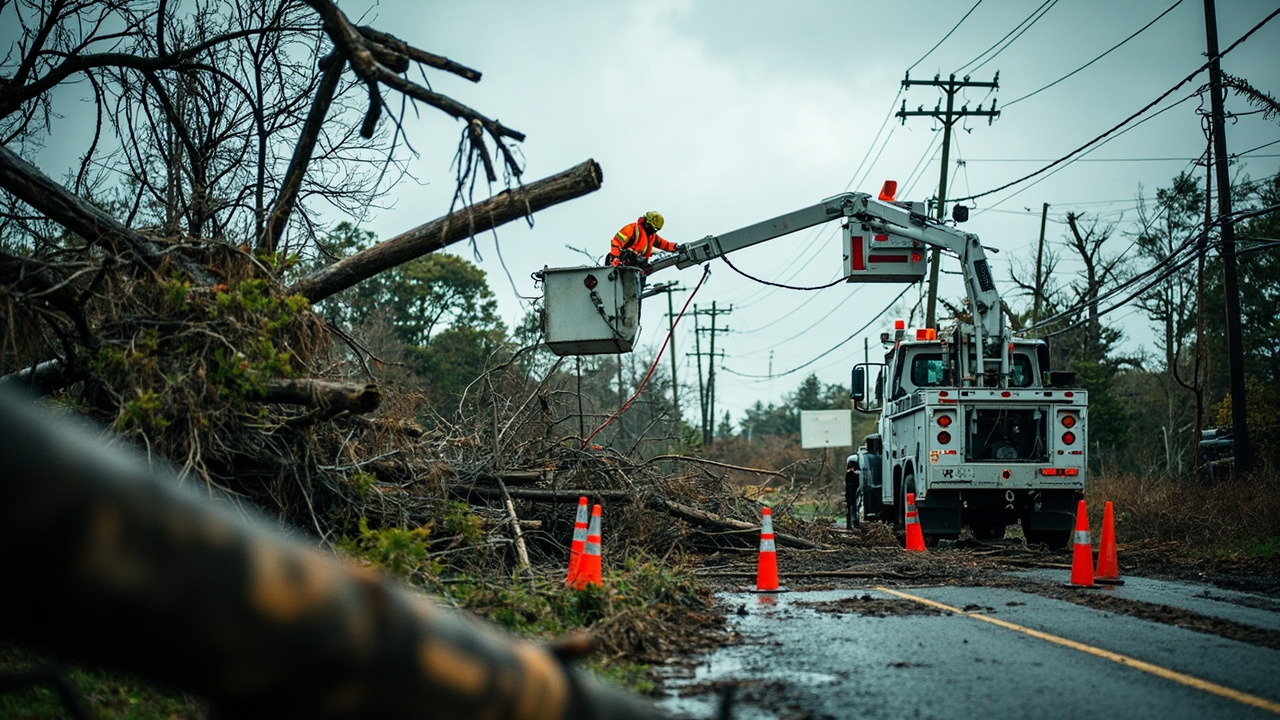
TL;DR: After a major storm, utilities assess damage, bring in outside crews, complete safety onboarding, then repair lines and re-energize sections in priority order — a sequence that can keep field teams deployed for about two weeks.
Why restoration takes longer than one repair
When severe weather tears down poles and wires, power does not return when a single crew fixes a single street. According to How Power Is Restored After a Major Storm | ElectriCom, utilities must assess damage, prioritize outages, mobilize crews and equipment, establish safe work zones, repair damaged infrastructure and systematically return sections of the system to service.
That sequence can expand quickly with storm size. The ElectriCom account notes that depending on severity, the work can involve hundreds of utility employees and contractors working long shifts across multiple communities.
A recent example shows the time scale households should be ready for. During a recent major storm response in Northwest Indiana, ElectriCom's Power team spent approximately 15 days supporting restoration after severe weather caused widespread infrastructure damage, according to that same ElectriCom report published Sept. 18.
A separate utility account points to a similar planning horizon. According to Inside Exelon's Effort to Get the Power Back on for 400,000 Customers, published Sept. 15, 2026, a ComEd emergency leader said the utility could have restored 400,000 customers with only its own lineworkers, but that approach would take about two weeks, which was described as not acceptable — prompting a call for mutual assistance.
For families, the takeaway is direct: plan for a multi-day outage even while crews are visible in the area, because visible crews do not mean the whole system is ready to be energized.
Step 1: Assessment teams map what still works
The first priority after a major storm is learning what happened to the electrical system, according to the ElectriCom account.
Assessment teams move into affected areas to identify damaged infrastructure and determine what remains operational. That information helps utilities understand where resources are needed and begin prioritizing restoration work.
In Northwest Indiana, the damage picture included extensive tree damage to overhead infrastructure. ElectriCom crews encountered downed primary lines, including three-phase and single-phase infrastructure, along with damage to open-wire secondary systems.
Crucially for expectations, that full picture is not available when outside help is first requested. The ElectriCom report states those conditions are not necessarily known in full when outside crews first receive the call, and damage assessments continue as restoration progresses.
That means assignments and priorities can change as the utility develops a clearer picture of its system. Households may therefore see crews survey an area without making repairs, then return later under a different work order.
Step 2: Utilities decide who can be sent
For contractors, mobilization starts with a practical staffing question described as “Who can we send?” in the ElectriCom report.
Experienced power crews are not waiting idle for severe weather. They are already working for utilities on existing projects, according to the same account.
When ElectriCom receives a storm call, Power leadership and construction managers determine which crews can be released without disrupting commitments to current customers. During the Northwest Indiana event, some crews could not be released because the utilities they were already supporting had also experienced storm damage.
Available resources were then organized for deployment. ElectriCom ultimately mobilized approximately 40 personnel, roughly eight crews plus support staff, and 39 pieces of equipment as part of that response.
The Exelon account describes the same mobilization pressure from the host-utility side. David Bunge, senior manager of emergency preparedness for ComEd, and his team had been monitoring the weather and the outage prediction model for days as storms approached, anticipating how many external crews would be needed.
How mutual assistance reaches a storm zone
When local resources cannot restore large customer counts fast enough, utilities request mutual assistance from sister utilities and contractors.
In the Exelon case, the request followed three waves of August storms in Illinois. According to that Exelon report, the first wave arrived Aug. 9, with eight tornadoes hitting the Chicago area late into the evening. The second wave came two days later, bringing 100 mph winds across northeastern Illinois and northwestern Indiana in what meteorologists call a “ring of fire” pattern, where clusters of thunderstorms circle around a dome of heat for several days. By the end of the week, the third wave arrived as torrential rainfall and flash flooding in central Illinois.
On a hot, muggy afternoon in August in Joliet, Illinois, tornado alerts sounded on phones inside ComEd’s Operations Control Center while severe storms swept northern Illinois, winds toppled trees and utility poles, and outages climbed, according to the Exelon account.
More than 750 miles away in Philadelphia, Shannon Rush, a Principal Arranger with PECO, one of ComEd’s sister utilities under the Exelon umbrella, received a call at 8 p.m. on Tuesday, Aug. 11, asking whether she would lead a team of lineworkers and support staff to help ComEd customers and crews.
After a fleet inspection and safety briefing with 26 lineworkers and 14 management and support staff — including fleet technicians, safety personnel, supervisors and foremen — the group left in a line of bucket trucks west on I-76, according to the Exelon report. Rush and co-lead Keith Wiest brought up the rear. The crew staged overnight with hotel rooms in Ohio, described as the halfway point, then arrived at a temporary basecamp in Joliet Junior College’s parking lot Thursday morning.
Crews from Atlantic City Electric, Delmarva Power and Pepco made the same journey after ComEd signaled Tuesday night that anticipated Chicago-area outages were mounting and mutual assistance would be essential, according to the same account. Inside the ComEd Operations Control Center in Joliet, external crew mobilization assistant Jamie Gaddis worked to enlist Exelon crews plus independent contractors and other outside crews.
Logistics shape speed. ElectriCom notes that years ago its crews sometimes traveled as a large caravan, but arriving dozens of vehicles at once at the same stop for fuel, food and supplies could turn a routine stop into hours of lost time. Today, crews are generally given a destination and required arrival time and allowed to travel independently to get resources into position without logistical bottlenecks.
Step 3: Outside crews must clear onboarding first
Arrival does not mean immediate repairs.
According to the ElectriCom report, outside crews typically must first complete the host utility’s onboarding and safety requirements before working on its electrical system.
During very large disasters, that process can take time because utilities may simultaneously be assessing damage, coordinating incoming contractors, determining crew assignments and establishing restoration priorities. ElectriCom’s Power leadership has experienced major deployments where crews waited days before receiving assignments.
During the Northwest Indiana response, the process moved considerably faster, but crews still had to stage and complete required onboarding before entering the field. Once complete, utility coordinators could begin directing crews toward specific restoration assignments.
The Exelon account shows what that handoff looks like on arrival. At the Joliet basecamp, the PECO crews met their ComEd liaisons, gained access to ComEd’s outage management system and started receiving tickets and work orders that identify outage location and type.
Residents should not interpret staged trucks or waiting crews as inaction. Staging is the point where safety clearance, system access and assignments are aligned before energized work begins.
Step 4: Repair, then systematic re-energization
Once assignments are issued, physical restoration begins, with the exact repairs depending entirely on the damage.
In Northwest Indiana, ElectriCom crews worked on damaged primary and secondary distribution infrastructure, including downed three-phase and single-phase primary lines and open-wire secondary systems, according to the ElectriCom account.
Crews may initially work relatively close together before being divided into different areas as restoration progresses. Unlike a planned project with defined scope, restoration crews may finish one assignment and immediately be redirected elsewhere based on current utility priorities.
The Exelon report describes similarly long, rotating field days. The PECO deployment worked 16-hour shifts with 8 hours to rest while tackling storm-damaged areas through physically demanding and dangerous rebuilding work.
Front-line conditions explain why the work is methodical. ComEd lineworker Charles Cook sheltered beneath a viaduct near Interstate 80 as tornado warnings flashed on his phone, then emerged to find trees blocking roads, wires and poles down, and fire departments spread through the area. He described it as the worst storm damage in 29 years at ComEd.
Utilities then return sections of the system to service systematically rather than energizing each repair in isolation. Households on an intact lateral may still wait while upstream damage, safety zones and switching steps are completed.
What to do while the sequence unfolds
Expect repeated weather hits to reset progress. Bunge summarized the August Illinois sequence by saying that just when outages appear under control, another wave can strike.
Keep essential needs covered for an extended outage, including food, water, medication, communications and backup power handled safely. Do not approach downed wires or damaged poles, and give active work zones room to operate. Report outages and hazardous conditions through the utility’s outage system rather than assuming a passing crew has the report.
Track the utility’s outage map and municipal notices for boil-water advisories, shelter information and supply distribution, because storm response often involves simultaneous hazards such as flooding. In the Illinois event, the final wave brought torrential rainfall and flash flooding in central Illinois after tornadoes and extreme winds, according to the Exelon account.
Above all, measure progress at the system level, not by one truck on one block. Assessment, crew mobilization, safety onboarding, infrastructure repair and controlled re-energization all have to happen in order before power stays on safely.