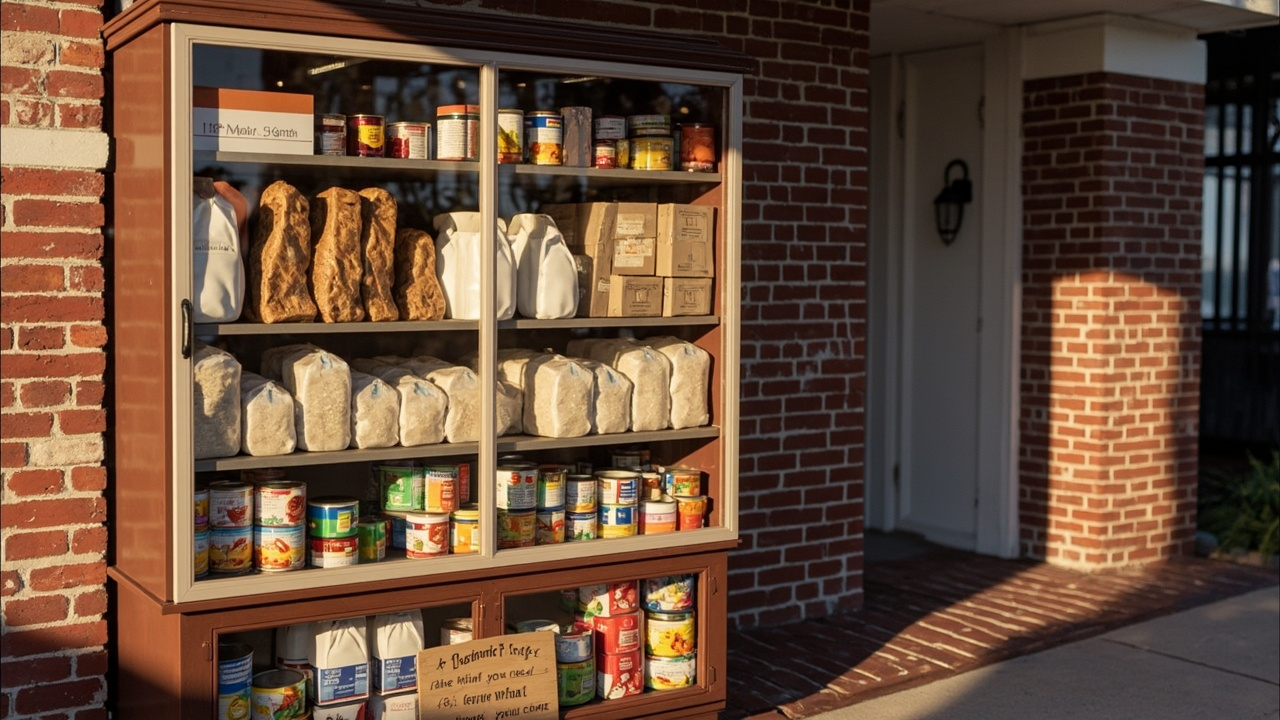
TL;DR: The Town of Townsend Community Pantry is open and stocked for anyone in need, with round-the-clock access and no paperwork.
The Town of Townsend announced on Friday, September 25th, 2026, that its Community Pantry is now open, according to the official municipal notice titled Community Pantry- NOW OPEN! - Town of Townsend - New Castle County Delaware. The notice was posted by the Town on its Delaware government website, and a same-day community announcement summarized the operating model in plain terms. The pantry is described as fully stocked and available 24 hours a day, 7 days a week for anyone in need. No application is required, no approval process applies, and no appointment is needed.
For households in southern New Castle County, that status matters for practical planning. The resource is positioned as a neighborhood-level food buffer that can be used at any hour, including evenings, weekends, and times when staffed offices are closed. Residents do not need to wait for business hours, explain circumstances, or complete intake forms before selecting food. The stated approach is to take what is needed and, when able, to leave something for others.
Where the pantry is located
The pantry is associated with Town operations at 141 Main Street in Townsend, Delaware 19734. That address is listed by the Town as its visit location and appears in the directory record for the Town of Townsend, Delaware, according to the GovServ community-mirror record titled Town of Townsend, Delaware, 141 Main Street, Townsend, DE (2026).
The municipal site provides a mapped visit link for 141 Main Street, Townsend, DE 19734. Travel planning is straightforward because the site is on Main Street in Townsend. People coming from nearby neighborhoods can use the Town’s posted map reference to confirm the building location before a first visit. The pantry itself is described as continuously accessible, which separates pantry access from Town Hall office hours.
When pantry access differs from Town Hall hours
Town Hall public hours are listed as 8 a.m. to 4 p.m. Monday through Friday. Those hours are relevant for staff-assisted business, donation drop-offs handled through Town Hall, and other municipal services. They do not limit pantry use.
The community announcement states that pantry availability continues around the clock, seven days per week. That means a household facing a late-night shortage, a weekend gap, a delayed paycheck, a storm-related travel problem, or a missed shopping trip can still obtain food without waiting for Monday morning. For preparedness purposes, residents can treat the pantry as an after-hours option as well as a daytime option. The distinction is important because many public assistance points operate only during weekday office hours.
What the pantry stocks
The September 25 announcement describes a broad mix of everyday foods. Items named include milk, fresh foods, bread, pasta, rice, canned vegetables, canned fruits, and premade meals. The emphasis is on both immediate-use foods and staple ingredients that support several meals.
Milk and fresh foods give households options that do not always appear in older dry-goods-only boxes. Bread and premade meals can cover an immediate need without cooking. Rice and pasta provide base ingredients that pair with canned vegetables, canned fruit, sauces, or other items already at home. Canned fruits and vegetables add shelf-stable produce that can round out meals when fresh supplies run low.
The Town uses the phrase fully stocked in the September 25 community message. Households should still understand that community pantries change through the day as neighbors take items and donors replenish them. A prudent approach is to visit with a short list of acceptable substitutes rather than expecting one exact item. If milk is unavailable during a particular visit, for example, another named category such as bread, rice, pasta, canned produce, or a premade meal may still meet the immediate need.
How no-barrier access works
The operating rules are deliberately simple. No application is required. No approval process is required. No appointment is needed.
That structure removes common barriers that keep people from seeking help, including paperwork, eligibility screening, scheduling, and waiting periods. Anyone in need may use the pantry. The community message frames the exchange as mutual aid rather than formal assistance: take what is needed and, if able, leave what can be shared.
For household planning, the absence of an appointment system means no reservation call is necessary before visiting the pantry shelves. Residents can incorporate the pantry into a broader food plan alongside home storage, retail purchases, school meals, faith-based support, and county programs. The pantry can fill a short gap, replace a missing meal ingredient, or reduce pressure during a high-expense week.
From Blessings Box to expanded Community Pantry
Town messages describe the new Community Pantry as an expansion of an existing Blessings Box effort. Earlier Town posts said the newly expanded pantry would offer fresh foods in addition to the shelf staples found in the existing Blessings Box.
That history explains why perishable capacity is central to the current announcement. A traditional box focused on shelf-stable goods can operate with limited infrastructure. Adding milk, fresh foods, and premade meals requires more attention to stocking, turnover, and safe handling. The Town’s September communications present the Community Pantry as the larger successor resource, with room for both fresh items and pantry staples.
Residents who used the Blessings Box previously will recognize the basic take-what-you-need approach. The expanded pantry continues that principle while widening the range of foods available. The change is especially relevant for families with children, older adults, and households without large home food reserves, because fresh foods and ready-to-eat options can be used quickly.
Grand opening event planned for September 29
Although the pantry was announced as now open on September 25, the Town also planned a grand-opening gathering for September 29 at 2 p.m. A September 22 Town message said the community was exactly one week away from the grand opening and invited residents to attend. An earlier September 10 message carried the same September 29 at 2 p.m. time and encouraged attendees to consider bringing a donation.
As of the September 25 archive date, the September 29 gathering remained a planned future event, not a completed outcome. The distinction matters for readers reviewing the timeline. The pantry’s open status did not depend on attending the later ceremony. The event was presented as an opportunity to see the expanded pantry, meet neighbors, and support the effort through donations.
Households interested in the event could plan to arrive for the stated 2 p.m. start and bring a contribution if able. Because the September 25 notice already described the pantry as open, residents needing food before September 29 did not need to wait for the ceremony.
How to donate and what Town Hall accepts
The Town asked residents who are able to help keep the shelves filled. Beginning September 22, donations of perishable items could be made at Town Hall, according to the Town’s September messages preserved in the GovServ community-mirror record titled Town of Townsend, Delaware, 141 Main Street, Townsend, DE (2026).
Perishable examples named by the Town include fruits, vegetables, milk, eggs, butter, and similar items. The Town asked donors to ensure that contributions are unopened, unused, and in good condition. The guidance was direct: if the donor would not eat it, it should not be donated.
That quality standard protects both recipients and the pantry’s fresh-food capacity. Unopened packaging helps preserve safety. Good-condition produce, dairy, and refrigerated staples reduce waste and keep the available selection usable. Residents planning a donation can check seals, cartons, and containers before traveling to Town Hall. Separating cold items for prompt drop-off also supports safe handling, particularly for milk, eggs, butter, and cut produce.
Nonperishable staples remain relevant as well because the pantry builds on the Blessings Box tradition of shelf-stable support. Rice, pasta, canned fruits, and canned vegetables are among the categories highlighted in the open announcement. A balanced donation might therefore combine a shelf-stable staple with a perishable item, where the donor is able to do so. The Town’s broader invitation was for neighbors to ensure that none of their neighbors go hungry.
Contact information and Town services
The Town lists its phone number as (302) 378-8082 and its fax number as (302) 378-7099. The municipal website is https://townsend.delaware.gov, where residents can find meeting materials, announcements, and service information. The Town also maintains an online contact form for questions, comments, and concerns.
Additional municipal contact paths shown on the Town site include a FOIA form and property-information requests. The Town invites residents to follow its Facebook presence for timeline updates. Those channels are useful for confirming Town Hall procedures, donation handling, meeting schedules, and future pantry announcements.
Committee and Planning Commission meeting information is also posted through the Town website. Residents can view documents through the meeting tab or join listed virtual options. While pantry access does not require attending a meeting, following Town communications can help households learn about replenishment drives, seasonal events, and other local support efforts.
Emergency alerts and household readiness
The Town website includes enrollment information for its Community Alert Network, presented alongside a CodeRed icon. That enrollment path is separate from food assistance, but it complements household readiness. Food access and emergency notification work best together: one addresses immediate nourishment, while the other delivers community alerts.
Residents building a basic readiness plan can save the Town Hall phone number, bookmark the Town website, and complete alert-network enrollment through the Town’s posted enrollment link. Keeping the pantry address with other household resources makes after-hours use easier. A written list of acceptable food substitutes also helps during a hurried visit.
The pantry model reinforces a practical self-reliance lesson. Home storage remains valuable, but community resources can cover shortfalls that storage alone does not solve, especially for milk, fresh produce, bread, and premade meals. Using the pantry when needed, replacing items when able, and donating surplus when possible keeps the shared supply available. The September 25 open announcement presents that cycle as the core of the Townsend effort: a stocked, continuously accessible pantry sustained by neighbors.